
Best Cat Water Fountains: How to Choose One You'll Keep Clean
Pick a cat water fountain by what you will actually wash: dishwasher-safe parts, filter intervals and power, plus what a 16-cat study found about drinking more.
PawCog earns a commission from qualifying purchases made through links marked “Paid link”, at no extra cost to you.
On this page
Quick answer: The best cat water fountain is the one whose bowl you will actually wash every day. Choose stainless parts you can put in the dishwasher, check how often the filter must be replaced, and pick cordless only if there is no outlet near your cat's favorite spot or you want a sensor mode. Fountains help some cats drink more, but not all of them.
 Chart
Chart
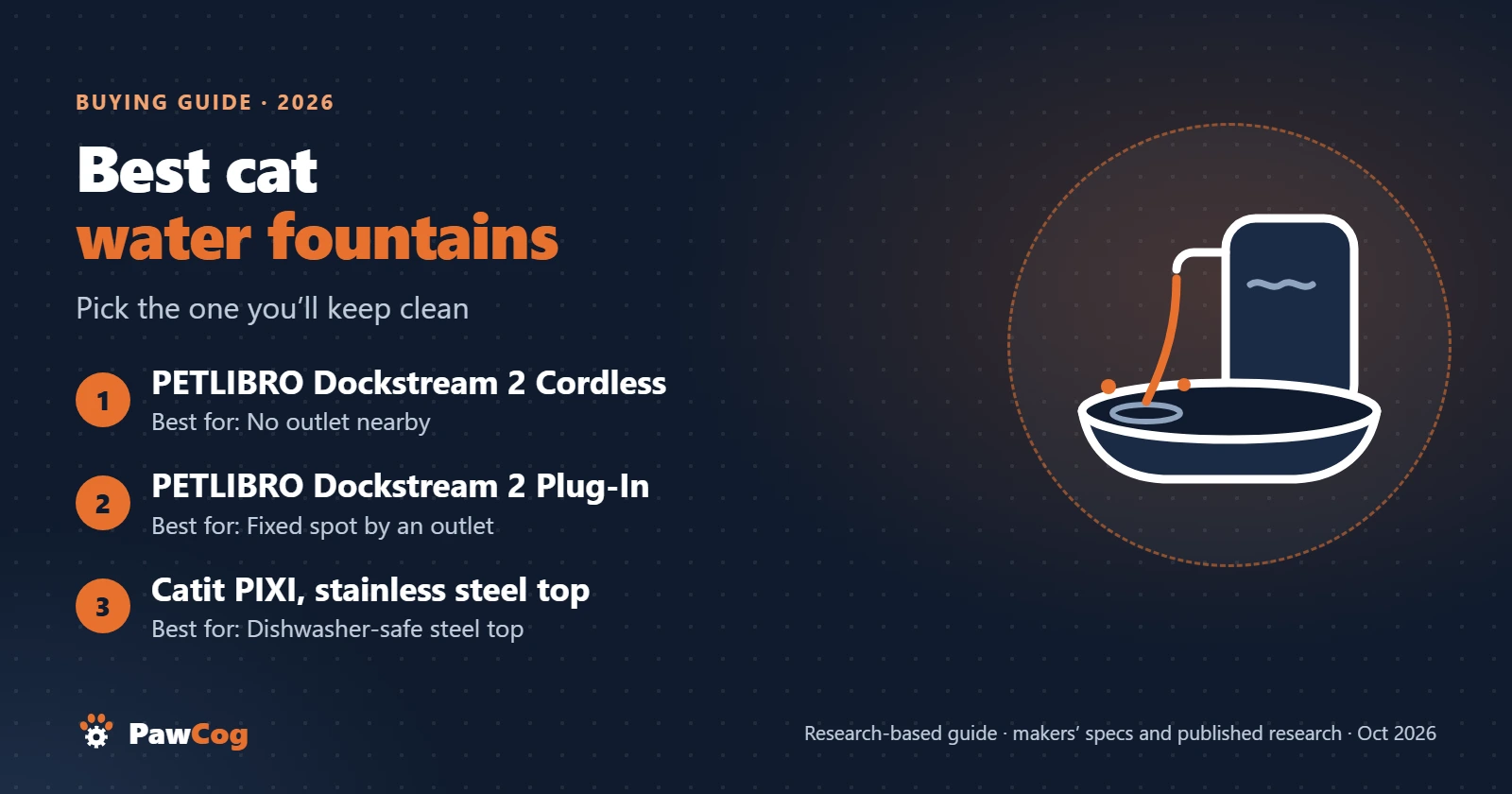
Our picks at a glance
| Fountain | Best for | Steel parts | What to know |
|---|---|---|---|
| PETLIBRO Dockstream 2 Cordless (Paid link) | A spot with no outlet nearby | Stainless steel tray | Battery-powered; PETLIBRO rates it at up to 30 days per charge for one cat in sensor mode. Each fountain tracks one cat. |
| PETLIBRO Dockstream 2 Plug-In (Paid link) | A fixed spot next to an outlet | Stainless steel tray (PETLIBRO lists it as dishwasher-safe) | Same 3 L tank and app as the cordless model, with continuous or timed flow and no battery to charge. |
| Catit PIXI with stainless steel top (Paid link) | A steel drinking surface that goes in the dishwasher | Stainless steel top cover | Catit says the steel top can go in the dishwasher, and sells a spare top separately so one can stay on the fountain while the other is washed. It has an LED indicator for low water. |
How to choose a cat water fountain
 Chart
Chart
1. Stainless steel parts you can wash every day
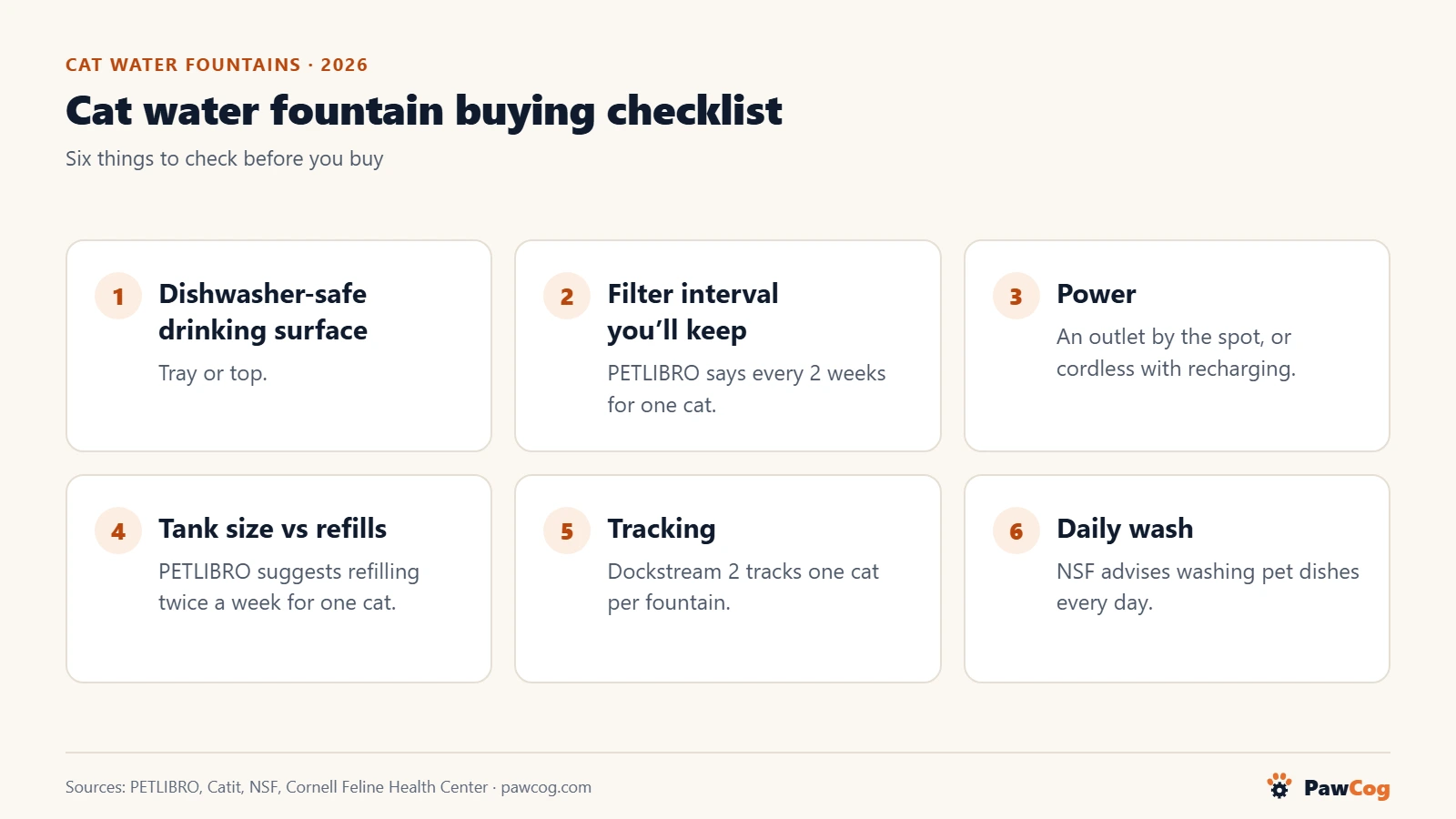
In a 2011 NSF germ study, 22 families swabbed 30 everyday household items, and pet dishes were the fourth germiest item in the homes analyzed. NSF advises washing pet dishes daily, either in a sanitizing dishwasher or by hand with hot soapy water. A fountain is a pet dish with more parts, so the part your cat drinks from should be easy to take off and wash. PETLIBRO lists a dishwasher-safe stainless steel tray for the Dockstream 2 Plug-In (its cordless listing mentions a detachable tank and a rinseable rotor instead), and Catit says the stainless steel top of the PIXI can be cleaned in the dishwasher.
2. Cat water fountain filter: interval and cost
Filters are the running cost of a fountain. PETLIBRO recommends replacing the Dockstream 2 filter every two weeks for one pet, and more often for several pets. It also says to soak a new filter before installing it, and that a filter is still needed if you fill the tank with purified water. PETLIBRO sells the Dockstream 2 in a bundle with 8 filters, which covers about four months for one cat at that interval.
3. Cordless or plug-in
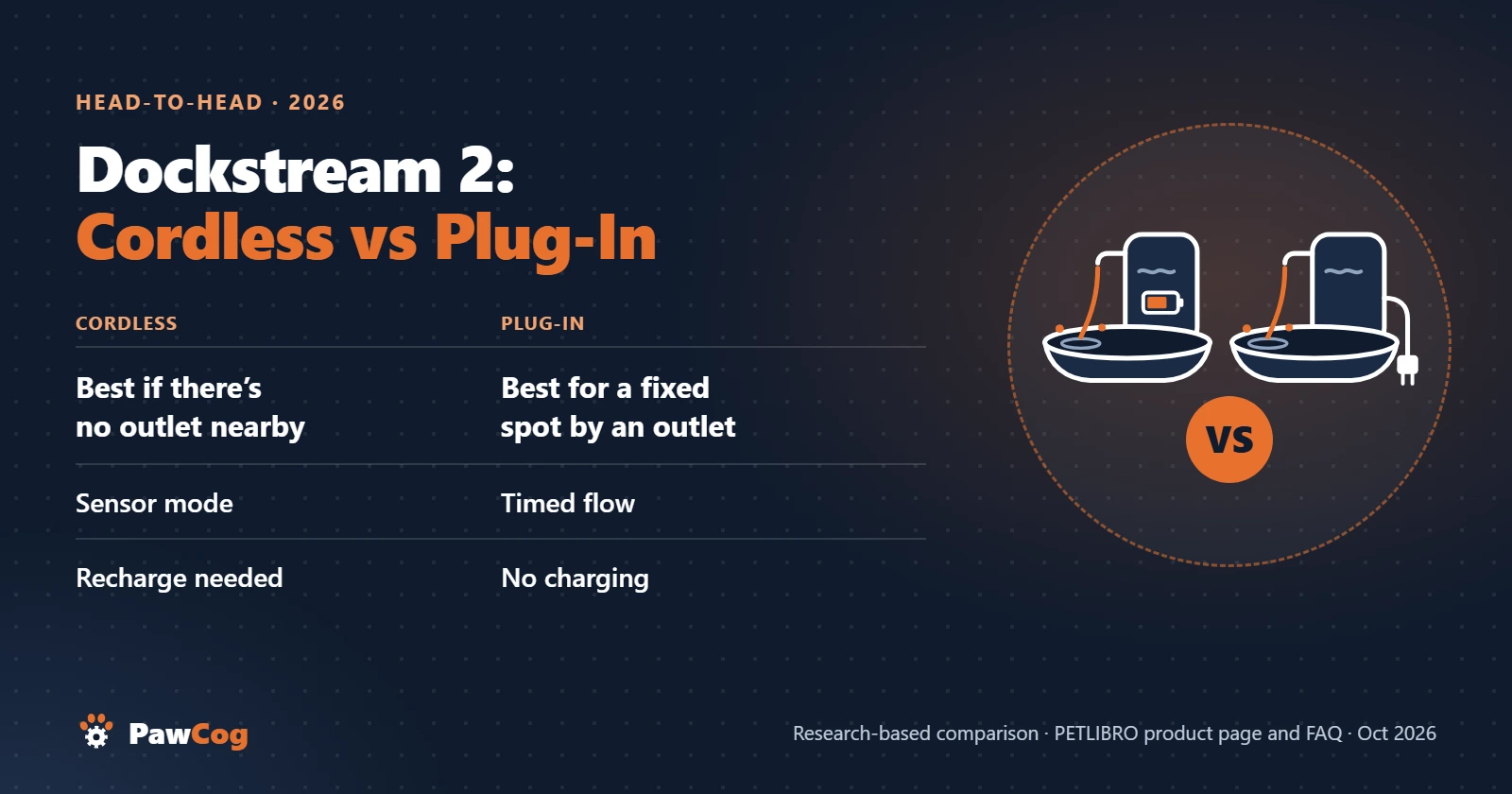
The two Dockstream 2 models share the same 3 L tank, the same dimensions (246 x 200 x 198 mm) and the same app. The differences, from PETLIBRO's product page:
| Dockstream 2 Cordless | Dockstream 2 Plug-In | |
|---|---|---|
| Power | Battery, 5200 mAh | Corded, no battery |
| Flow modes | Continuous or pet-activated sensor | Continuous or timed |
| Battery life | Up to 30 days for one pet in sensor mode | Not applicable |
| Charging | About 7 to 8 hours, up to 10 hours while running | Not applicable |
| Net weight | 1.89 kg | 1.77 kg |
PETLIBRO bases its 30-day figure on a full charge, one pet, sensor mode, and 30 drinking sessions a day of 45 seconds each, and says battery life may be shorter with several pets. Choose cordless when the best spot for your cat has no outlet or you want the sensor mode; otherwise the plug-in model gives you the same tank and app without a battery to charge, with timed flow in place of sensor mode, and it was the cheaper of the two on PETLIBRO's own store when we checked.
4. Tracking and alerts
Both Dockstream 2 models track one cat's water intake, number of drinking sessions and average drinking time in the PETLIBRO app, and send refill, filter and low-water reminders. PETLIBRO notes that drinks under about 2 ml may not register, and that in the cordless model's sensor mode a cat drinking from behind may not be detected; if that happens, it suggests placing the fountain against a wall. If you want each of several cats tracked separately, PETLIBRO points to its Dockstream RFID model instead.
Do cats drink more from a fountain?
Sometimes. Cornell University's Feline Health Center says some cats increase their water intake when given a fountain, but individual preferences vary.
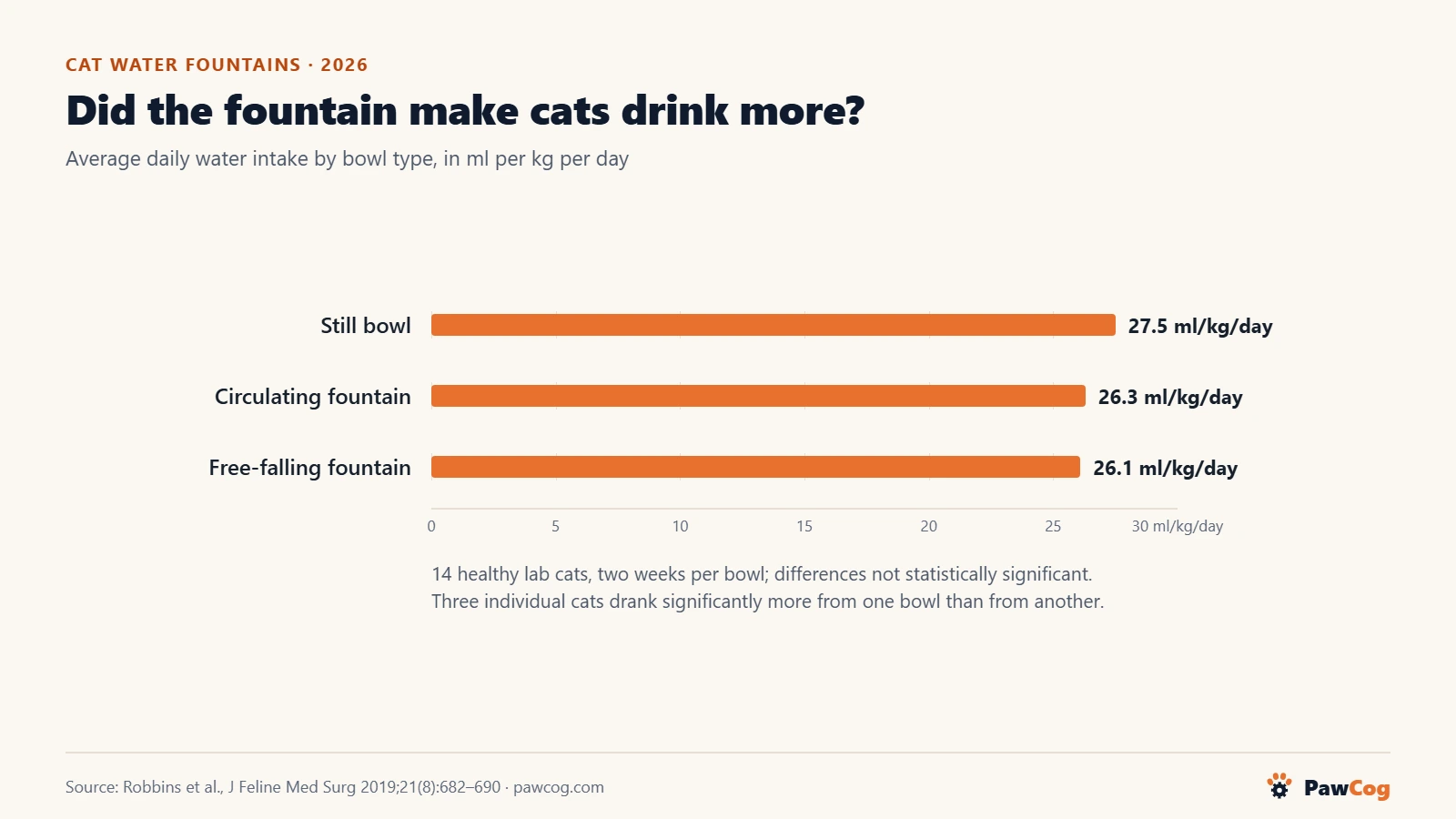
A study in the Journal of Feline Medicine and Surgery (Robbins and colleagues) gave 16 healthy laboratory cats a still bowl, a circulating bowl and a free-falling bowl in turn, two weeks each. Among the 14 cats that completed the study, average daily water intake did not differ significantly between bowl types: about 27.5 ml/kg per day from the still bowl and 26.3 ml/kg per day from the circulating bowl. Three individual cats did drink significantly more from one bowl than from another: one from the circulating bowl rather than the still bowl, one from the still bowl rather than the circulating bowl, and one from the free-falling bowl rather than the circulating bowl. The authors concluded that other ways of increasing water intake should be used, not only special bowls, for cats that need to drink more.
 Chart
Chart
What this means for you: a fountain is worth trying if your cat likes running water, and a clean bowl refilled every day may work just as well for a cat that does not. Cornell lists other ways to encourage drinking: keep fresh water available in places your cat can easily reach, avoid conflicts between pets at the water bowl, and consider wet food or adding water to food. If you think your cat is dehydrated, Cornell advises contacting a veterinarian promptly.
How much water does a cat need?
According to Cornell's Feline Health Center, a cat needs roughly 4 ounces of water a day for every 5 pounds of lean body weight, which works out to about a cup for a typical 10-pound cat. Wet food can be up to 80% water, so cats on wet food may drink less from the bowl.
A simple cleaning routine
- Every day: wash the part your cat drinks from, as NSF advises for pet dishes: in a sanitizing dishwasher if the maker says that part is dishwasher-safe, or by hand with hot soapy water, then rinse.
- Once a week if you wash by hand: NSF suggests a bleach soak of 5 tablespoons (1/3 cup) of bleach per gallon of water with one minute of contact time, then a thorough rinse and air drying. Check your fountain maker's cleaning instructions before using bleach on any part.
- About every two weeks for one cat: replace the filter (PETLIBRO's interval for the Dockstream 2), sooner with several cats.
- Twice a week for one cat: refill the tank, as PETLIBRO recommends for its fountains.
Which one should you buy?
- PETLIBRO Dockstream 2 Cordless (Paid link) if your cat's favorite spot has no outlet, or you want the sensor mode, and you want to see one cat's drinking in an app. Plan to recharge it; PETLIBRO says battery life may be shorter with more than one cat.
- PETLIBRO Dockstream 2 Plug-In (Paid link) if the fountain can sit next to an outlet. You get the same 3 L tank and app without managing a battery, and PETLIBRO lists this model's stainless steel tray as dishwasher-safe.
- Catit PIXI with stainless steel top (Paid link) if you mainly want a steel drinking surface you can put in the dishwasher. Catit sells a spare top separately, so one can stay on the fountain while the other is washed.
- No fountain if your cat ignores running water. Wash your cat's water bowl daily and use the other ideas above.
Prices change often; follow the links for the current price.
FAQ
How often to clean a cat water fountain?
Wash the bowl or drinking tray every day, as NSF advises for pet dishes. For filters, follow the maker: PETLIBRO recommends a new Dockstream 2 filter every two weeks for one pet, and more often for several pets.
Is a cordless cat water fountain worth it?
It is worth it if there is no outlet where your cat likes to drink, or if you want the pet-activated sensor mode, which PETLIBRO lists only for the cordless Dockstream 2. Otherwise the plug-in model avoids recharging, and it was the cheaper of the two on PETLIBRO's own store when we checked. PETLIBRO also says battery life may be shorter with several cats.
Do I still need a filter if I use filtered or purified water?
PETLIBRO says yes for its Dockstream 2: the filter is still needed with purified water.
Is a stainless steel cat water fountain better?
On the fountains in this guide, stainless steel matters mostly for cleaning: PETLIBRO lists the Dockstream 2 Plug-In's stainless steel tray as dishwasher-safe, and Catit says the PIXI's stainless steel top can go in the dishwasher. That makes the daily wash NSF recommends for pet dishes easier.
Can one fountain track several cats?
The Dockstream 2 tracks one cat at a time. PETLIBRO's Dockstream RFID model is the one it suggests for tracking several cats separately.
More for cat owners
- PETLIBRO Dockstream 2 Cordless vs Plug-In: Which Should You Buy?
- Best Automatic Cat Feeders With a Camera
- Best Pet Cameras With Treat Dispensers
How we researched
We compared the makers' specifications for the PETLIBRO Dockstream 2 and the Catit PIXI with guidance from Cornell University's Feline Health Center, NSF's household germ study and a study of water intake in cats published in the Journal of Feline Medicine and Surgery. We did not buy or test these fountains. Product details were checked on October 16, 2026.
Sources
- Hydration, Cornell Feline Health Center
- Robbins MT et al., Quantified water intake in laboratory cats from still, free-falling and circulating water bowls, and its effects on selected urinary parameters, J Feline Med Surg 2019;21(8):682–690, published online October 10, 2018
- NSF, Clean the Germiest Home Items
- PETLIBRO Dockstream 2 Smart Fountain
- Catit PIXI Drinking Fountain with stainless steel top
How we evaluated
- Charts from real data: 3
More from PawCog
PETLIBRO Dockstream 2 Cordless vs Plug-In: Which Should You Buy?
The two PETLIBRO Dockstream 2 versions share the tank and app. The real differences are power, flow modes, battery upkeep, weight and price.
Best Air Purifiers for Pet Owners of 2026
How to size an air purifier for pet dander, avoid ozone from ionizers and plan for filter costs, plus six current picks from Winix, Levoit, Blueair, Coway and Shark.
Best Robot Vacuums for Pet Hair of 2026
We compared current Roborock, Dreame, MOVA and Shark robots on what matters with pets: hair on carpet, tangled brushes, pet-waste avoidance, dock bags and running costs.